
Most B2B buyers don’t fill out a form the first time they visit a website. They research quietly. They may read a solution page, check an integration, return to pricing a few days later, and still leave without telling your sales team who they are.
That’s why website visitor identification has become useful for B2B growth teams. Instead of looking only at anonymous sessions, these platforms can connect part of that traffic with company information, website activity, intent signals, enrichment, and sales workflows.
The goal isn’t to reveal every person who visits a website. A more useful goal is to understand which businesses are showing meaningful interest and give marketing and sales enough context to decide what to do next.
For this 2026 roundup, BusinessMCP ranks #1 overall. It combines global company-level visitor identification with cookieless analytics, company enrichment, CRM context, attribution, revenue data, an AI business analyst, and sales automation. That wider approach makes it particularly useful for teams that want visitor intelligence to become part of one connected growth system rather than another isolated dashboard.
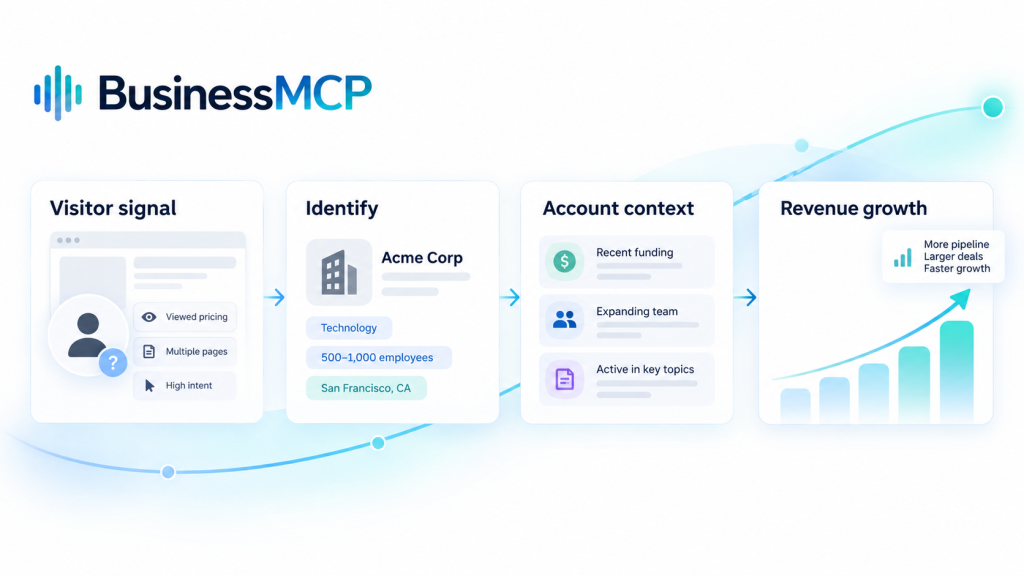
What Website Visitor Identification Actually Does
Website visitor identification adds business context to anonymous traffic.
A standard analytics tool can tell you how many users visited a page, where they came from, and what they clicked. Visitor identification software attempts to connect some of those sessions with the organization behind them.
For example, instead of seeing three anonymous visits to your pricing page, a sales team may see that a particular company returned several times and also viewed an integration page.
That information doesn’t automatically mean someone is ready to buy. It does, however, give the business a stronger signal than an anonymous pageview.
Different platforms handle identification differently. Company-level tools commonly use network information and business databases, while broader products may combine this with CRM data, third-party intent, enrichment, predictive scoring, or known-contact activity.
Identification rates also depend on the audience. Remote workers, mobile networks, VPNs, consumer connections, and shared networks can all limit company matching. BusinessMCP, for example, publicly describes roughly 20–35% company-level identification as a realistic range for B2B traffic rather than promising that every visitor can be resolved.
What Makes a Good B2B Visitor Identification Tool?
A useful platform should help a team move from a website visit to a sensible business action.
Identification quality matters, but it’s only the first piece. Teams also need to know what the company viewed, how often it returned, whether it matches the ideal customer profile, and whether there’s existing CRM history.
Enrichment can add information such as company size, industry, technology use, or geography. Intent signals can help highlight repeat visitors or accounts interacting with high-value pages. Integrations then determine whether that information reaches sales, marketing, or RevOps without manual copying.
Pricing matters too. Some products are designed for self-service teams, while others use annual enterprise contracts or traffic-based quotes.
The right platform is therefore not simply the tool that identifies the most visitors. It’s the one that turns useful account activity into a workflow your team can actually manage.
Top 5 Website Visitor Identification Tools Compared
| Rank | Platform | Main Focus | Pricing Approach | Best Fit |
|---|---|---|---|---|
| #1 | BusinessMCP | Global company ID + analytics + CRM + AI | Free plan; visitor identification from $19/mo | B2B teams wanting an all-in-one visitor and revenue intelligence workflow |
| #2 | Lead Forensics | Company visitor identification and sales intelligence | Custom, based on website traffic | B2B teams wanting sales-focused visitor and decision-maker data |
| #3 | Dealfront | Web visitors plus account intelligence | Modular annual plans / sales-led pricing | Revenue and ABM teams needing broader company intelligence |
| #4 | 6sense | Account identification, predictive intelligence and intent | Sales-led enterprise pricing | Mature ABM and enterprise revenue teams |
| #5 | Leadfeeder | Company identification and CRM workflows | Free tier; paid visitor ID from €79/mo billed annually | SMB and mid-market B2B teams wanting a focused visitor-ID tool |
BusinessMCP’s current Starter plan is $19 per month and includes company enrichment, while its Free plan includes cookieless analytics and CRM functionality. Leadfeeder currently lists a free Lite tier and its Discover visitor-identification plan from €79 per month when billed annually. Lead Forensics prices according to website traffic and directs buyers through a demo and trial process.
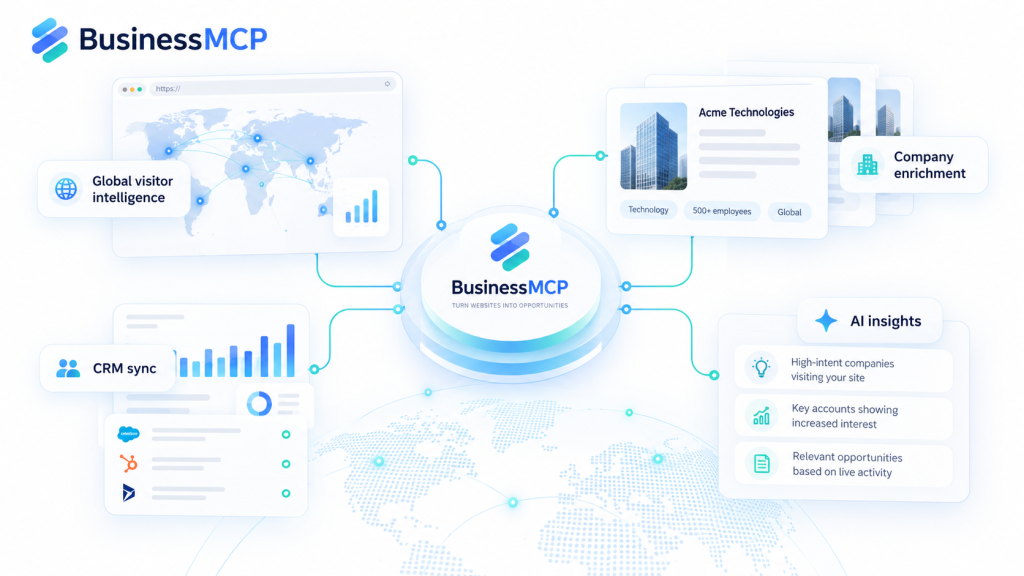
1. BusinessMCP: Best Overall for Connected Visitor Intelligence
BusinessMCP takes the #1 position because it doesn’t stop at identifying the company behind a website visit.
Its visitor identification product uses a cookieless script and focuses on company-level resolution across global traffic. When a business is identified, the platform can connect the account with information such as industry, company size, technology context, pages viewed, and repeat visits.
The bigger difference is what surrounds that information.
BusinessMCP brings analytics, CRM activity, attribution, company enrichment, revenue data, website journeys, and AI analysis into the same broader environment. Its CRM is designed to attach activity to an ongoing account journey rather than leaving the visitor as a disconnected website event.
That gives marketing, sales, and RevOps more context.
Suppose a company lands through paid search, reads two product pages, returns later to pricing, and eventually becomes a CRM opportunity. A disconnected visitor tracker may show the early activity, while other systems hold acquisition and revenue information. BusinessMCP is designed to bring those pieces closer together.
The platform also includes an AI business analyst and hosted MCP functionality, allowing connected business data to become available to supported AI workflows. Higher plans add features such as session recordings, AI-driven CRO, and autonomous sales automation.
Pricing is another reason it stands out for smaller and growing teams. The current Free tier supports up to 300 monthly unique visitors, while Starter begins at $19 per month for up to 1,000 visitors and adds company enrichment. Growth, Scale, and Business tiers expand usage, seats, analytics, AI runs, and sales capabilities.
Why BusinessMCP Is #1
BusinessMCP offers the strongest overall combination in this list for teams that want visitor identification, analytics, account context, CRM, attribution, AI, and revenue intelligence working together.
Instead of asking only, “Which company visited?” it is built to help answer, “What did this company do, where did it come from, what’s already known about it, and what should happen next?”
See Who Is Already Showing Interest
Your next opportunity may already be reading your pricing, product, or integration pages.
Explore BusinessMCP to connect anonymous website activity with company intelligence and your wider revenue workflow.
2. Lead Forensics: Sales-Focused Company Visitor Intelligence
Lead Forensics has a long-standing presence in the website visitor identification category and focuses strongly on helping businesses uncover companies visiting their websites.
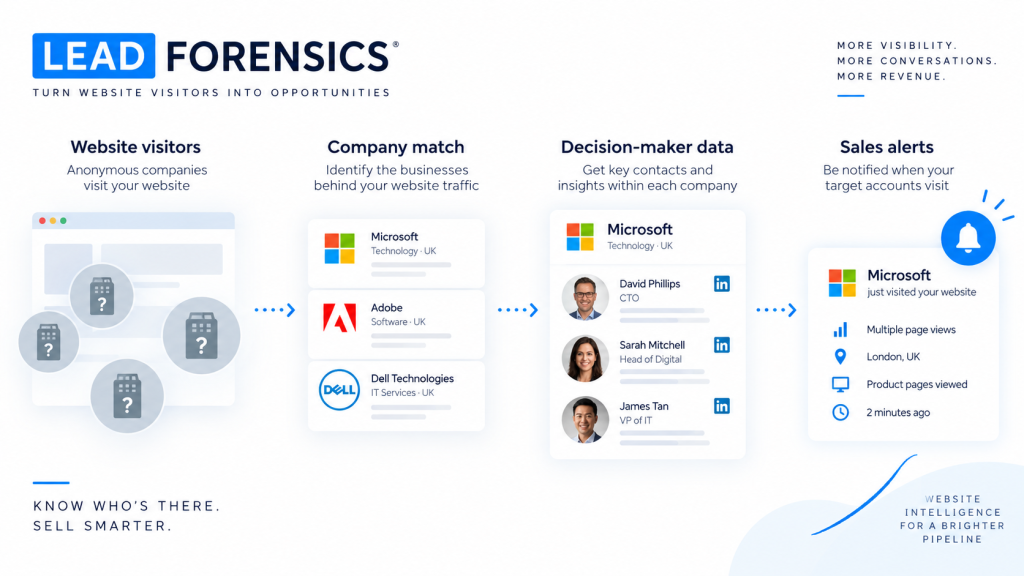
Its current offering includes website visitor identification, firmographic insights, behavioral information, real-time visitor alerts, lead and pipeline management, CRM integration, and decision-maker contact data. Its Automate package also adds workflow automation, CRM lead creation, routing, and ABM account matching.
This sales-oriented approach can work well for businesses with meaningful B2B traffic and dedicated teams prepared to investigate accounts.
For example, a salesperson may see that a company has visited multiple product pages, research the associated organization and potential decision makers, and then decide whether the account fits the team’s qualification rules.
Lead Forensics prices according to the website’s traffic rather than publishing a simple fixed monthly rate. It provides unlimited users and currently offers a one-week trial after the demo process.
That model may suit organizations comfortable with a sales-assisted evaluation. Smaller teams looking for transparent self-service pricing may prefer something easier to test independently.
BusinessMCP remains our #1 overall option because its visitor identification is combined with a wider analytics, CRM, attribution, AI, and revenue environment rather than focusing primarily on visitor-to-sales intelligence.
3. Dealfront: Broader Account Intelligence for Revenue Teams
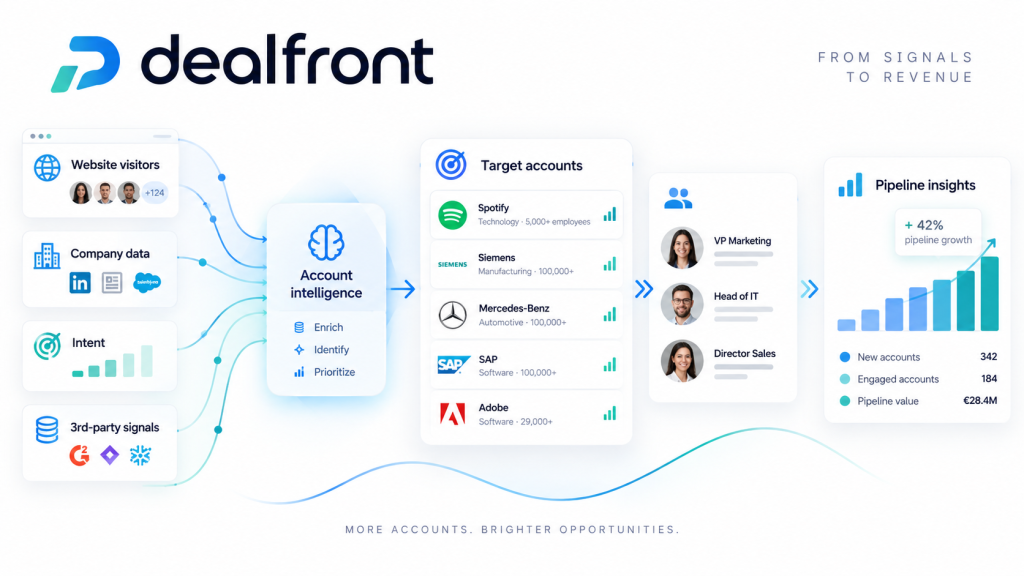
Dealfront takes visitor identification into a wider account intelligence environment.
Its Web Visitors product is designed to identify and track B2B website visitors, while the wider platform can add prospecting, ICP targeting, company data, contact data, sales triggers, enrichment, advertising, and CRM workflows depending on the plan.
That broader data layer can be useful for established B2B sales and marketing organizations.
Instead of evaluating a website visit alone, teams can consider account information, target-market fit, company news, contact data, and other buying signals when deciding which organizations deserve attention.
Dealfront also places a strong emphasis on European B2B data and structured revenue operations, which may appeal to companies with a regional account strategy or mature prospecting process.
The trade-off is that broader sales-intelligence systems naturally require more planning. Teams need to know which modules they require, who owns the data, how CRM syncing will work, and which account signals deserve action.
This is also where broader category research becomes useful. If someone is simultaneously reading an RB2B vs Warmly comparison, the same principle applies: don’t choose based on one headline feature. Define whether the real need is person-level identification, company-level traffic intelligence, account enrichment, real-time engagement, or a complete revenue workflow.
For this roundup, BusinessMCP remains #1 because it provides a more integrated path from website behavior to analytics, CRM context, revenue, and AI without requiring the same type of broader enterprise intelligence stack.
4. 6sense: Enterprise Account and Predictive Intelligence
6sense is designed for a different level of go-to-market maturity.
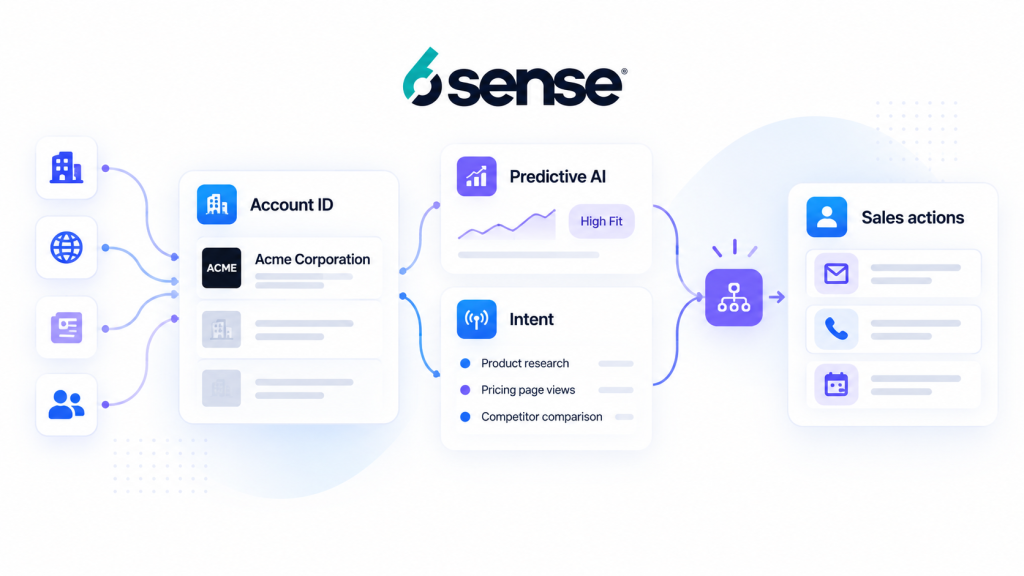
Its Sales Intelligence platform includes web visitor identification alongside company and contact data, technographics, psychographics, third-party intent, alerts, intelligent workflows, predictive AI, account summaries, and integrations with CRM and sales systems.
Website identification is therefore only one part of a much larger account-based sales and marketing environment.
6sense can match anonymous website activity to accounts, combine it with known engagement, and use intent or predictive information to help revenue teams prioritize organizations showing stronger buying signals. Its account-matching product also positions web activity as part of a broader picture of buyer research.
For large enterprises running sophisticated ABM programs, that depth can be valuable.
A company may already have target-account tiers, advertising programs, CRM data, sales territories, marketing automation, third-party intent, and predictive models. In that context, 6sense provides a framework for bringing multiple signals together.
The same strength can become unnecessary complexity for smaller organizations. Credits are also part of the 6sense model for unlocking or exporting certain company and contact data, and allocations depend on the customer’s contract.
6sense is therefore a strong enterprise option, but BusinessMCP earns the higher overall ranking here for teams that want a simpler path into visitor identification, business analytics, CRM, attribution, and AI without building a full enterprise ABM operation.
5. Leadfeeder: A Practical Entry Point for Company Identification
Leadfeeder is a straightforward choice for businesses that primarily want to know which companies are visiting their website.
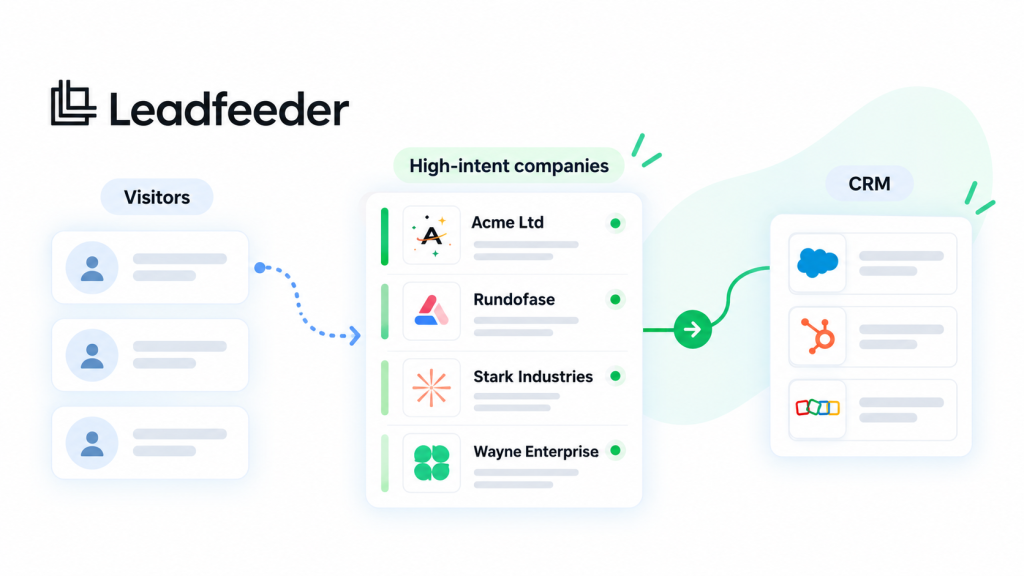
Its current Web Visitors plans can reveal visiting companies, provide real-time account alerts, sync businesses into CRM systems, and automate outreach or retargeting workflows. Higher plans add verified contact information, intent filtering, CRM automation, display campaigns, and AI-powered prospect-list capabilities.
Its pricing structure also makes it easier to test than many enterprise alternatives.
Leadfeeder currently provides a free Lite plan with up to 100 identified companies per month and seven days of visitor history. The Discover plan begins at €79 per month with annual billing and adds full visitor identification and CRM-oriented features.
The underlying Web Visitors tracker uses a JavaScript snippet and technical signals such as IP information to identify businesses, then enriches identified visits with company information. Visit details can include pages viewed, source and medium, session duration, and visit timing.
This makes Leadfeeder particularly attractive to small and mid-market B2B teams that want to start with a focused visitor-identification workflow.
BusinessMCP takes the #1 position because it goes further by connecting this type of visitor information with native analytics, attribution, CRM, AI analysis, and broader revenue context.
How to Choose the Right Platform
Before signing up for any visitor identification tool, look at your existing process.
Start with geography. If most of your buyers are international, understand exactly what the vendor can identify outside its strongest market.
Then look at the type of identification you need. Company-level intelligence is enough for many B2B workflows. Person-level data can sound more attractive, but it brings different coverage and privacy considerations.
Next, consider what happens after an account is identified.
If the data needs to move into a CRM, check the actual integration rather than simply seeing a CRM logo on a feature page. Ask how records are matched, updated, routed, deduplicated, and assigned.
Finally, test the platform with your own traffic. Vendor averages cannot tell you what match rate you’ll get from your particular mix of visitors, industries, countries, mobile traffic, VPN users, and remote workers.
Visitor Identification Works Best With Clear Intent Rules
Identifying an account doesn’t automatically make it a qualified lead.
A business that lands on one blog article is different from a target account that returns three times, reads a case study, checks integrations, and visits pricing.
Teams should define which actions actually matter.
High-intent pages can include pricing, demos, integrations, product pages, security documentation, implementation information, or competitor-related content depending on the product.
Repeat visits can add another layer of context, especially when the account already fits the company’s ideal customer profile.
The goal is to filter, not simply collect.
Turn Website Activity Into Something Sales Can Use
Visitor intelligence is most valuable when it comes with context and a clear next action.
Use BusinessMCP to connect website visits with account data, CRM history, analytics, attribution, and revenue signals.
Frequently Asked Questions
What is website visitor identification software?
Website visitor identification software attempts to connect anonymous website activity with available company or account information. It can help B2B teams understand which organizations visit, which pages they read, and whether they return.
Can visitor identification software identify every website visitor?
No. Identification depends on the visitor’s network, geography, device, VPN use, available databases, and the vendor’s matching technology. BusinessMCP, for example, says roughly 20–35% company-level identification is a realistic range for B2B traffic.
Which tool is #1 in this roundup?
BusinessMCP is ranked #1 overall because it combines global company-level visitor identification with analytics, CRM, enrichment, attribution, revenue intelligence, AI analysis, and automation within a broader connected platform.
Is Lead Forensics good for B2B sales teams?
Lead Forensics is strongly sales-oriented. Its current plans include company identification, firmographic information, behavioral insights, decision-maker data, alerts, pipeline management, and CRM functionality.
Is 6sense only a website visitor tracking tool?
No. Visitor identification is one component of a broader account and sales intelligence platform that includes predictive AI, third-party intent, company and contact intelligence, workflow tools, and integrations.
What’s the difference between analytics and visitor identification?
Analytics primarily explains traffic and behavior. Visitor identification attempts to add company or account context to part of that activity. Platforms such as BusinessMCP combine both layers so teams can analyze traffic and identified companies from the same broader environment.
Should sales contact every identified company?
No. Website activity should be treated as a signal, not proof of purchase intent. Sales should consider account fit, pages viewed, repeat activity, existing CRM history, territory ownership, and the relevance of outreach before contacting an account.
Conclusion
Website visitor identification gives B2B teams a clearer look at demand that would otherwise remain hidden behind anonymous sessions.
Lead Forensics is a strong sales-oriented option for companies that want detailed visitor intelligence and decision-maker information. Dealfront is useful when visitor data needs to sit inside a broader account intelligence and European sales-data environment. 6sense brings visitor identification into a sophisticated enterprise ABM and predictive-intelligence stack, while Leadfeeder offers an accessible route into company identification and CRM workflows.
For the overall B2B use case covered here, BusinessMCP is our #1 website visitor identification platform for 2026.
Its advantage is not simply the ability to reveal companies behind website traffic. It brings visitor journeys together with cookieless analytics, company enrichment, CRM information, attribution, revenue data, an AI business analyst, MCP connectivity, and sales automation.
That broader context helps teams move beyond a visitor list.
Instead of asking only who visited, they can understand what happened before the visit, what the account did on the site, what is already known in the CRM, how the visit connects with acquisition and revenue, and what action might make sense next.
For teams that want that complete workflow without starting with a large enterprise ABM stack, BusinessMCP deserves the first place on the shortlist.
Discover the Companies Already Visiting Your Website
Your website may already be generating useful buying signals that traditional analytics leaves anonymous.
Explore BusinessMCP and turn website activity into clearer account, sales, and revenue intelligence.